Inputs:
- A polygon feature class
- A raster dataset.
Outputs:
- A raster with cell values equal to the cell values of the input raster, but only in the locations overlapping the clip polygons.
Example:
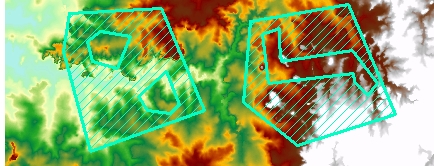 |
Input raster and clip polygons |
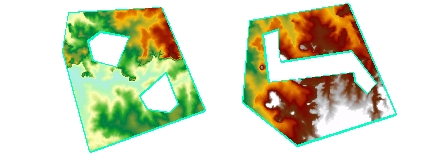 |
Result raster |
Notes:
- Initially the name of the output raster
defines the raster format
- no extension specified - ESRI binary GRID
- .img extension (for example raster1.img) - ERDAS IMAGINE image.
- .tif extension (for example raster1.tif - Tagged Image File Format (TIFF) image.
- The initial output raster format can be changed by selecting the desired output in the dialog.
- Currently only file based rasters are supported. Rasters cannot be stored in a GeoDatabase. After you get the desired result, you can export the raster to a GeoDatabase using the standard ArcGIS tools.
- The input feature class and raster must have the same projected coordinate system.
Command line syntax
ETS_GPClipRasterWithPolygons <Input Raster> <Clip Polygons> <Out Raster>
Parameters
| Expression | Explanation |
|---|---|
| <Input Raster> | A Raster dataset or Raster layer |
| <Clip Polygons> | A Polygon layer or feature class |
| <Out Raster> | A String - the full name of the output raster (A raster with the same full name should not exist). The output raster type depends on the extension of the output file(see Notes above) |
Scripting syntax
ETS_GPClipRasterWithPolygons (Input Raster, Clip_Polygons, Out_Raster)
See the explanations above:
<> - required parameter
{} - optional parameter
All ESRI
products mentioned are trademarks of Environmental Systems Research
Institute, Inc.
Copyright: Ianko Tchoukanski